

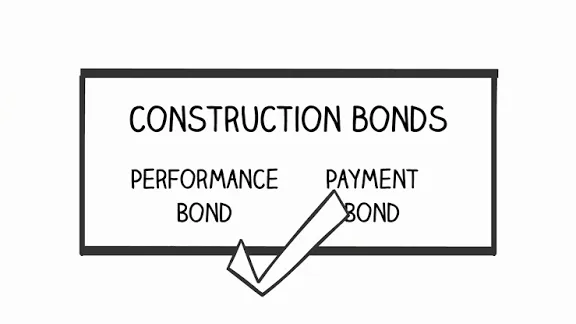
Bonds are a standard fixture of construction contracting. Public projects almost always require them by law. Private owners frequently demand them even when no statute forces the issue, simply because a bond shifts risk off their books and onto a surety.
Understanding how bonds actually work matters for more than compliance — it affects your bid pricing, your cash flow, and what rights you have (and how fast you have to act on them) if something goes wrong.
What Are Surety Bonds?
A surety bond is a three-party arrangement. You, the contractor, are the principal. The bonding company is the surety. The project owner or, in a payment-bond context, the general contractor above you is the obligee.
You pay the surety a premium and the surety issues the bond, which guarantees to the obligee that you’ll meet your contractual obligations. If you fail to perform, the surety steps in — either by paying to complete the work, paying claimants directly, or funding you to finish the job.
It’s a common misconception that a bond works like insurance. It doesn’t. You remain fully liable for the underlying obligation; the surety typically has a right of indemnification against you for whatever it pays out. The bond is a guarantee to the obligee, not a release of your own liability — think of it as the surety fronting the money and then coming back to collect from you.
Performance Bonds Explained
A performance bond guarantees that the contracted work actually gets completed. If you default — through bankruptcy, abandonment, or simply failing to perform to the contract’s requirements — the owner can make a claim, and the surety will either fund a replacement contractor to finish the job or pay the owner for the cost of completion.
Bond amounts commonly run 50% to 100% of the contract price, sized to cover the realistic cost of bringing in a new contractor mid-project (which is almost always more expensive than the original contract rate, since replacement contractors price in the disruption and lack of continuity).
Filing a Performance Bond Claim
An owner making a claim must generally give the surety formal notice of default and demonstrate the contractor actually failed to perform — the surety isn’t obligated to pay out on a bare allegation. Most bond forms and many states also require the surety be given an opportunity to investigate and, in some cases, to cure the default itself (for example, by stepping in to complete the work through the original contractor under supervision) before the owner can force a straight payout. Sureties routinely push back on claims that skip these procedural steps, so an owner pursuing a claim should follow the bond’s own notice and cure provisions exactly, not just the general contract’s default clause.
Payment Bonds Explained
A payment bond protects the people below the general contractor in the payment chain — subcontractors, sub-subcontractors, and material suppliers — by guaranteeing they get paid even if the general contractor doesn’t pay them.
Payment bonds are mandatory on federal projects under the Miller Act, and most states have adopted their own version — often called a “Little Miller Act” — requiring payment bonds on state and local public works. Because public property generally can’t be liened, the payment bond functions as the substitute security for unpaid subs and suppliers on public jobs; without it, they’d have very little recourse.
Filing a Payment Bond Claim
Payment bond claims are unforgiving on procedure, and missing a deadline can permanently bar an otherwise valid claim.
The process generally works like this: if you don’t have a direct contract with the general contractor (a second- or third-tier sub, or a supplier to a subcontractor), most statutes require you to send a preliminary notice — sometimes called a notice to owner or notice of furnishing — within a set window after you first provide labor or materials, often 20 to 90 days depending on the jurisdiction. Skip this step in a state that requires it, and you may lose your bond rights entirely regardless of how much you’re actually owed.
Once payment is overdue, you file the actual bond claim, typically on the surety’s own claim form, with supporting documentation: contracts or purchase orders, delivery tickets or time records, invoices, and a clear calculation of the unpaid balance. Most statutes also impose a hard filing deadline — commonly 90 days to a year from your last date of work or delivery — after which the claim is time-barred no matter the merits. If your unpaid claim involves a state public-works project, Construction Lawyer’s Security of Payment team can help confirm which notice and filing deadlines apply before they run out.
Federal Bonding Requirements
The Miller Act governs bonding on federal construction contracts over $100,000, requiring both a performance bond and a payment bond sized and structured to federal specifications. It also sets the procedural rules for making a payment bond claim on a federal job, including a requirement that most subcontractors without a direct contract with the prime give written notice within 90 days of their last work.
Bonding obligations aren’t limited to contracts directly with a federal agency — projects that receive federal funding indirectly, including through grants or tax-credit financing, frequently trigger Miller Act-equivalent bonding requirements as a condition of that funding, so it’s worth checking the funding source, not just who signed the contract, before assuming state rules apply instead.
State Bonding Requirements
Most states require bonds on public works contracts through their own Little Miller Act statutes, with thresholds, notice periods, and claim deadlines that vary meaningfully state to state. Private projects generally aren’t required by law to carry bonds unless the contract itself calls for one — but many sophisticated private owners require them anyway as a condition of financing or as standard risk management.
Bid Bonds
A bid bond guarantees that if your bid is accepted, you’ll actually sign the contract and provide the required performance and payment bonds. It protects the owner against a low bidder who wins the job and then walks away or refuses to sign, which would otherwise force the owner to re-bid on a delayed timeline.
Bid bond amounts are typically 5% to 10% of the bid, and the bond is released once the contract is signed and the performance/payment bonds are in place.
Bond Cost and Underwriting
Premiums for performance and payment bonds are typically 1% to 3% of the bond amount, though the rate you actually pay depends heavily on underwriting. Sureties evaluate your financial statements, working capital, bonding history, and past claims experience — contractors with strong balance sheets and a clean claims history pay meaningfully less than contractors with thin capitalization or a history of defaults, and a surety can decline to bond a contractor it considers too high-risk altogether.
Because underwriting looks closely at working capital and project history, contractors who are chronically slow to collect payment on completed work often find their bonding capacity shrinking even when their actual project performance is solid — which is one more reason unresolved payment disputes are worth pursuing promptly rather than letting them sit.
Bond Disputes
Disputes over bond coverage come up in a few recurring forms: sureties denying a claim as untimely or improperly noticed, disputes over whether particular labor or materials are actually covered by the bond’s scope, and disagreements over the amount owed when the underlying contract itself is in dispute. Because a surety’s defenses often track the notice and procedural requirements described above almost exactly, the strongest position on a bond claim is usually built at the notice stage, not after a denial. When a claim is denied and the dispute needs to be pursued further, Construction Lawyer’s debt recovery team works through exactly this kind of dispute.
Need help understanding your bonding requirements or pursuing a bond claim? Our law firm works with contractors and sureties to ensure compliance and to file and defend bond claims. Contact us for a free consultation about your bonding needs.